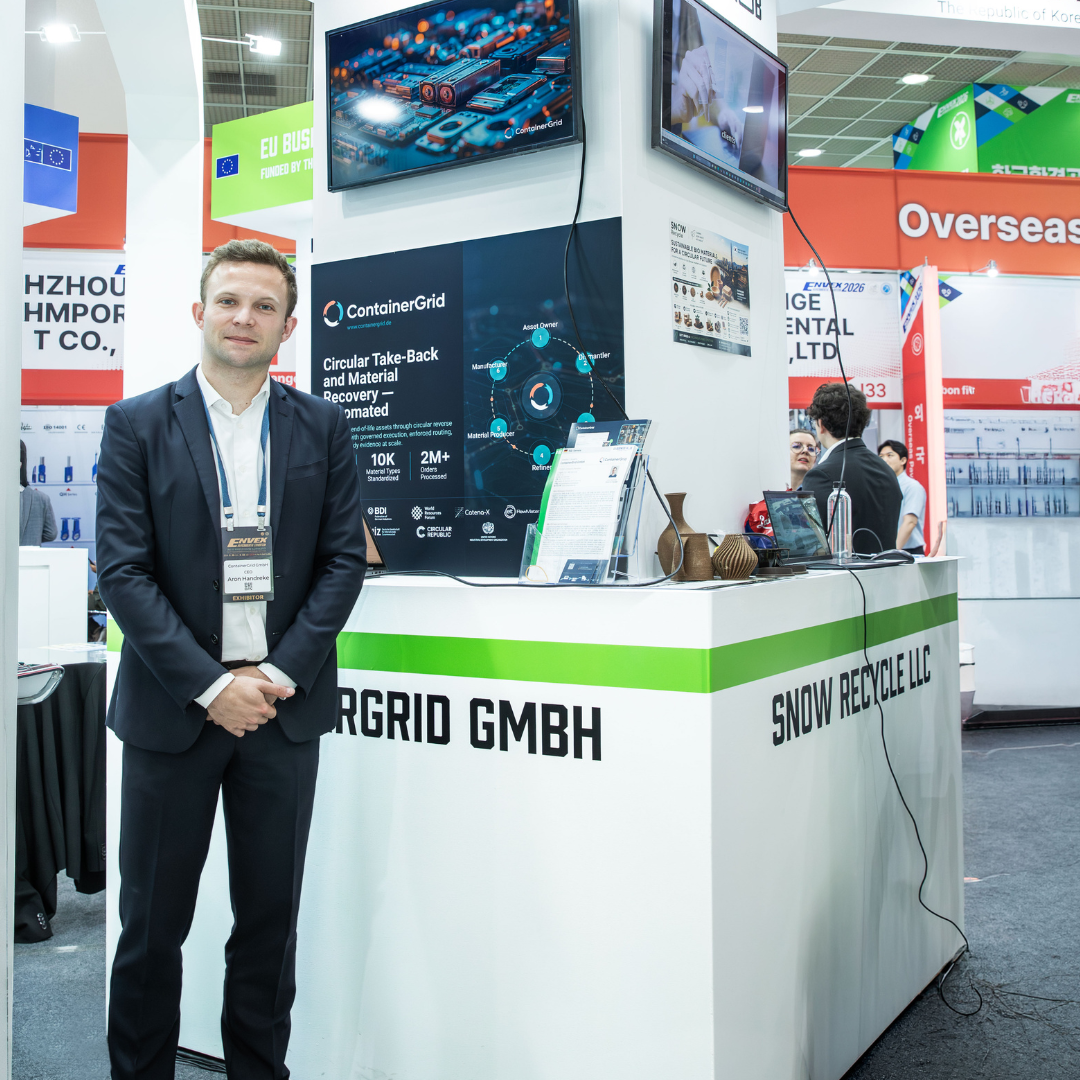
From Munich to Tokyo: how ContainerGrid is building circular supply chains across borders
When ContainerGrid GmbH joined the EU Business Hub @Smart Energy Week Spring 2026 mission, the Munich-based start-up came to Japan to explore how its technology for circular supply chains could support one of the world’s most advanced industrial economies.
Over four days in Tokyo, the startup engaged with Japanese industrial players across energy, automotive, electronics, logistics and recycling, exploring how its platform could support increasingly complex circular economy operations.
ContainerGrid focuses on one of the least coordinated parts of the industrial economy: end-of-life management for complex industrial equipment and materials. Its platform helps manufacturers, recyclers and logistics operators manage collection, recovery and reuse operations across fragmented industrial networks, providing greater visibility, traceability and coordination between partners. Today, the company works with more than 70 operators and connects into a network of over 3,500 facilities.
For CEO and Co-Founder Aron Handreke, Japan emerged as a particularly relevant market for the company’s technology and long-term ambitions.
“Japan is a manufacturing powerhouse with enormous installed bases of industrial assets across the globe,” he says. “Energy infrastructure, commercial vehicles and electronics will all need to be recycled, recovered or replaced at scale over the coming decades. That is precisely the problem we solve.”
Early alignment, Concrete Direction
ContainerGrid approached the mission with a highly focused strategy. Rather than attending broadly, the team prepared in advance for specific categories of stakeholders: asset owners, industrial manufacturers, recyclers, metals refiners, and potential local go-to-market partners.
“We were very targeted,” Handreke explains. “I was not there to collect business cards. I prepared a detailed matchmaking strategy and pre-researched each company.”
Over the course of the mission, the company held more than 15 meetings with Japanese stakeholders across sectors including energy, automotive, electronics, shipping, metals refining, logistics and construction. According to Handreke, the discussions moved far beyond introductory conversations.
“The matchmaking sessions were genuinely productive – not the usual trade fair small talk, but substantive conversations with decision-makers,” he says.
Meetings included exchanges with major Japanese metals refiners, commercial vehicle manufacturers, shipping lines, energy generators, real estate conglomerates, and multinational electronics companies. The EU Green Transition Pavilion also played an important role in helping the startup establish credibility in a highly relationship-driven market.
“The EU Business Hub team clearly invested in understanding our profiles and matching us with relevant Japanese counterparts,” Handreke notes. “Having a professional booth at the EU Green Transition Pavilion and bilingual printed materials made a tangible difference in establishing credibility with Japanese stakeholders.”
What particularly surprised the company was the depth and technical specificity of the conversations.
“I expected Japanese companies to be cautious and relationship-driven, and that is true,” says Handreke. “But I was impressed by how concretely they engaged with the operational details of our platform.”
“Several counterparts asked very specific questions about subcontractor qualification workflows, hazardous transport integration, and virtual material account mechanics. The level of engineering curiosity was higher than I had anticipated.”
Unexpected sectors, real opportunities
Before arriving in Tokyo, ContainerGrid expected the strongest interest to come from energy infrastructure and automotive industries. Those sectors did respond strongly – but the mission also revealed opportunities in areas the company had not initially prioritised.
Construction and demolition companies showed interest in orchestrating recycled building materials. Leasing companies explored ways to trace assets through to end-of-life recycling. Logistics groups began discussing ship recycling and materials recovery.
Across industries, one challenge appeared repeatedly: fragmented contractor ecosystems with limited group-level visibility.
“The concept of consolidating fragmented waste management contractors into a single portal for group-level visibility and traceability clearly hit a nerve across very different industries,” Handreke says.
By the end of the mission, the company had built a pipeline of approximately 15 qualified leads. Three opportunities are already progressing towards scoping projects, including discussions with a major shipping line, a commercial vehicle manufacturer and a metals refining company interested in scaling e-waste and copper collection.
The mission also led to two emerging advisory relationships that could support ContainerGrid’s localisation strategy in Japan, as well as an invitation to apply for a Global Innovation Challenge by a multinational electronics company.
Beyond market entry
For a startup with fewer than five employees, the scale of access achieved during the mission would have been difficult to build independently, admits Aron Handreke.
“The institutional credibility of the EU Business Hub, the pre-arranged matchmaking, the pavilion infrastructure – these are things that would have cost us months of outreach and tens of thousands of euros to replicate on our own,” Handreke says.
“As a ratio of investment to pipeline quality, this is among the most efficient business development activities I have done.”
ContainerGrid is now preparing tailored follow-up materials and planning additional visits to Japan to continue discussions and advance pilot projects further. The company aims to secure at least one signed pilot project in Japan within the next six months.
Reflecting on the experience, Handreke summarises the impact simply:
“The EU Business Hub gave us something an early stage startup and first-time founders cannot build alone: institutional access to Japanese industrial decision-makers, in the right setting, at the right time. In four days, we built a pipeline that would have taken us a year to develop independently.”
 Tokyo, Japan
|
|
Green and Low-Carbon Technologies
Tokyo, Japan
|
|
Green and Low-Carbon Technologies