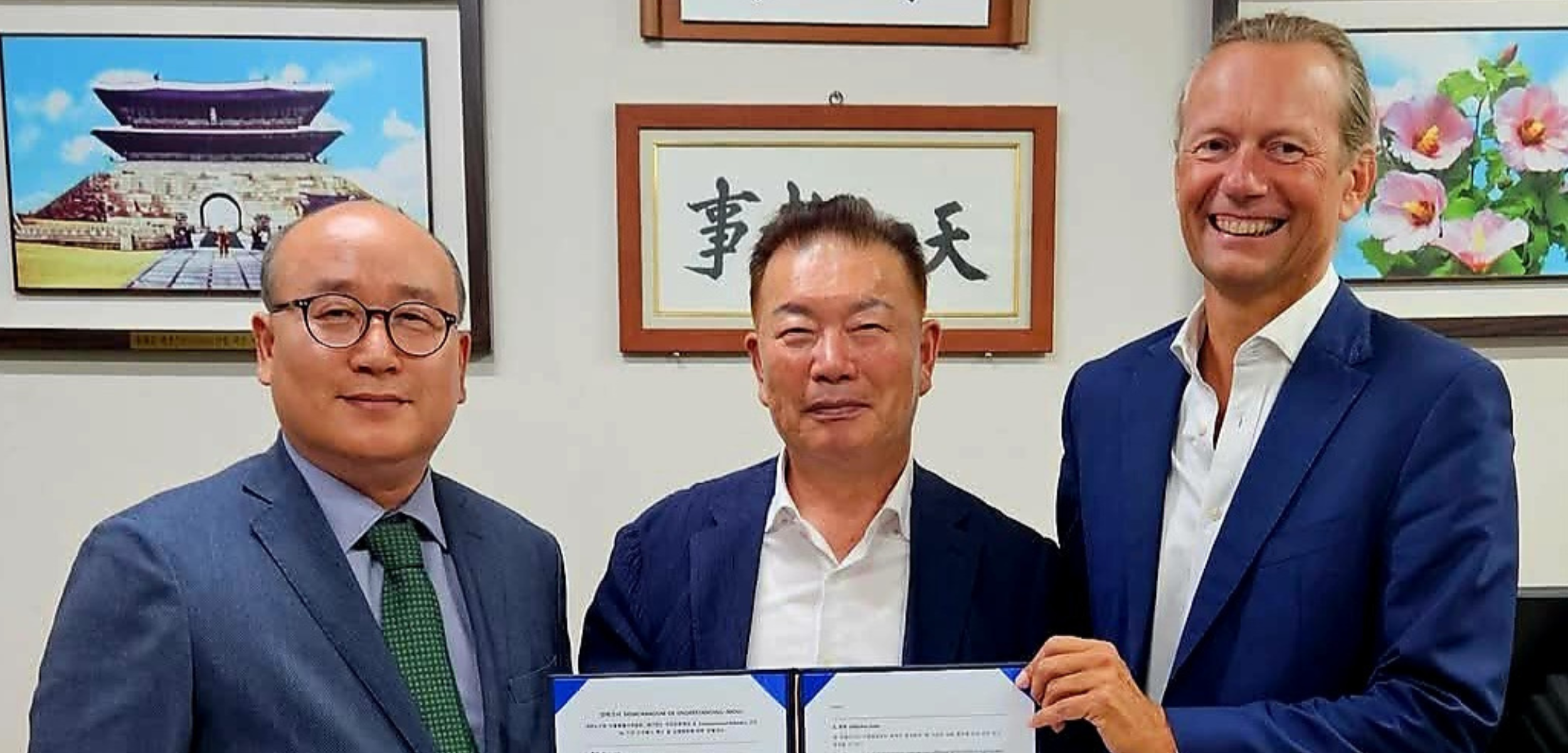
From three business missions to a national partnership: How Entertainment Robotics is bringing AI-enabled dementia prevention to the Republic of Korea
When Danish health technology company Entertainment Robotics first joined the EU Business Hub healthcare mission to the Republic of Korea in 2025, its objective was straightforward: to explore opportunities in one of the world's fastest-ageing societies.
Rather than treating market entry as a one-time opportunity, the company adopted a long-term approach.
Between 2025 and 2026, Entertainment Robotics participated in three EU Business Hub business missions across the Republic of Korea and Japan: Healthcare and Medical Equipment Korea 2025, EU Business Hub @ KIMES 2026 and EU Business Hub @ World Health Expo 2026. Each mission helped the company deepen its understanding of the market, strengthen relationships and move closer to the right institutional partners.
That continued engagement proved decisive. During its KIMES 2026 mission to the Republic of Korea in March 2026, the company established a strategic partnership with one of Korea's largest senior citizens' organisations, creating a pathway to bring evidence-based dementia prevention programmes to millions of older adults across the country.
For Founder and CEO Dr. Henrik Hautop Lund, the experience fundamentally changed how he thinks about international growth.
Turning exercise into a game
At the heart of Entertainment Robotics' technology is Moto Tiles, an interactive health technology platform that transforms physical and cognitive training into an engaging, game-based experience.
The technology was developed in response to a challenge shared by ageing societies around the world: while physical activity is essential for maintaining mobility, balance and cognitive health, traditional rehabilitation programmes are often repetitive and difficult to sustain. By combining movement, play and data-driven monitoring, Moto Tiles aims to make preventive training more engaging and easier to maintain.
"Prevention only works if people stay engaged," says Dr. Lund. "The challenge was to create something that combines measurable health benefits with an experience people actually want to repeat."
Why the Republic of Korea?
The Republic of Korea has become one of the world's most compelling markets for healthcare innovation.
The country has officially entered the category of a super-aged society, with more than one-fifth of its population (10.8 million) aged 65 or older. As the number of older adults continues to rise, so does the prevalence of dementia, falls and other age-related health challenges.
At the same time, the Republic of Korea has embraced digital transformation and is increasingly investing in AI-enabled healthcare and welfare solutions.
"For an evidence-based prevention technology like ours, it is hard to imagine a better-matched market," Dr. Lund explains.
However, entering a market like the Republic of Korea presents significant challenges for European businesses. Building relationships, understanding local business culture and identifying trusted partners can take years.
"The EU Business Hub offered what a company like ours needs most: a serious platform, meetings arranged in advance with the right people, and the standing that comes with arriving under the EU flag, which genuinely carries weight in Korea."
From repeated engagement to a breakthrough partnership
During the EU Business Hub @ KIMES 2026 mission, which marked the company's second EU Business Hub healthcare mission in Asia, Entertainment Robotics exhibited at KIMES 2026, one of Asia's leading medical technology exhibitions, while also participating in a programme of pre-arranged business meetings.
The company entered the mission looking for distribution partners and institutions that could support large-scale implementation. Instead, it discovered something much bigger.
"The most valuable outcome was meeting the Seoul Federation of the Korea Senior Citizens Association," says Dr. Lund. "I had come hoping to find good distribution partners. I did not expect to leave in serious dialogue with an organisation that represents millions of older Koreans."
That single conversation transformed the scale of the opportunity.
"It changed the size of the opportunity in my mind – from selling equipment to helping build a national prevention programme."
The partnership itself emerged from a connection facilitated during the EU Business Hub mission, demonstrating how targeted matchmaking can accelerate market entry for European SMEs and start-ups.
From matchmaking to a strategic partnership
Following the mission, Entertainment Robotics signed a strategic cooperation agreement with the Seoul Federation of the Korea Senior Citizens Association, which represents more than 3.3 million members, and the Department of Social Welfare at Seogang College.
The partnership focuses on expanding Moto Tiles-based dementia prevention programmes across Korea's elderly welfare sector while also developing AI-enabled welfare services, professional training programmes and research initiatives.
According to Dr. Lund, the agreement succeeded because both sides shared the same vision.
"We were not persuading a reluctant market. We were meeting partners who already wanted the same thing."
The partnership gives Entertainment Robotics something that many SMEs struggle to achieve independently: direct access to a national network, an educational partner capable of training professionals and a realistic pathway towards integrating its technology into long-term prevention programmes.
"This is market entry at a level we could not have reached on our own."
The experience also reshaped the company's internationalisation strategy. Rather than pursuing direct sales in every new market, Entertainment Robotics now sees partnership-based expansion as the most effective approach.
"It settled that our path is partnership-led – working through institutions that already have reach, rather than trying to sell directly in every new country."
The company also discovered that building a presence in Asian markets requires patience, trust and repeated engagement rather than a single visit. At the same time, the business missions accelerated its growth ambitions.
"With the right platform and the right partners, a small Danish company can realistically aim at national-scale impact and move faster towards it than I had assumed."
Looking ahead
Entertainment Robotics is now moving from agreements to implementation.
Building on the relationships established through its participation in EU Business Hub missions, the company is preparing its first programme rollouts with its Korean partners, developing professional training programmes with Seogang College and continuing discussions with stakeholders across both markets.
Follow-up visits are already planned, and the company hopes to continue participating in future EU Business Hub missions.
For Dr. Lund, the value of the programme can be summarised in a single sentence:
"The EU Business Hub helped transform three business missions into a national partnership. A small Danish company now has the partners to bring evidence-based, AI-enabled dementia prevention to millions of older Koreans – something we could never have done alone."
 Osaka, Japan
|
|
Healthcare and Medical Equipment
Osaka, Japan
|
|
Healthcare and Medical Equipment